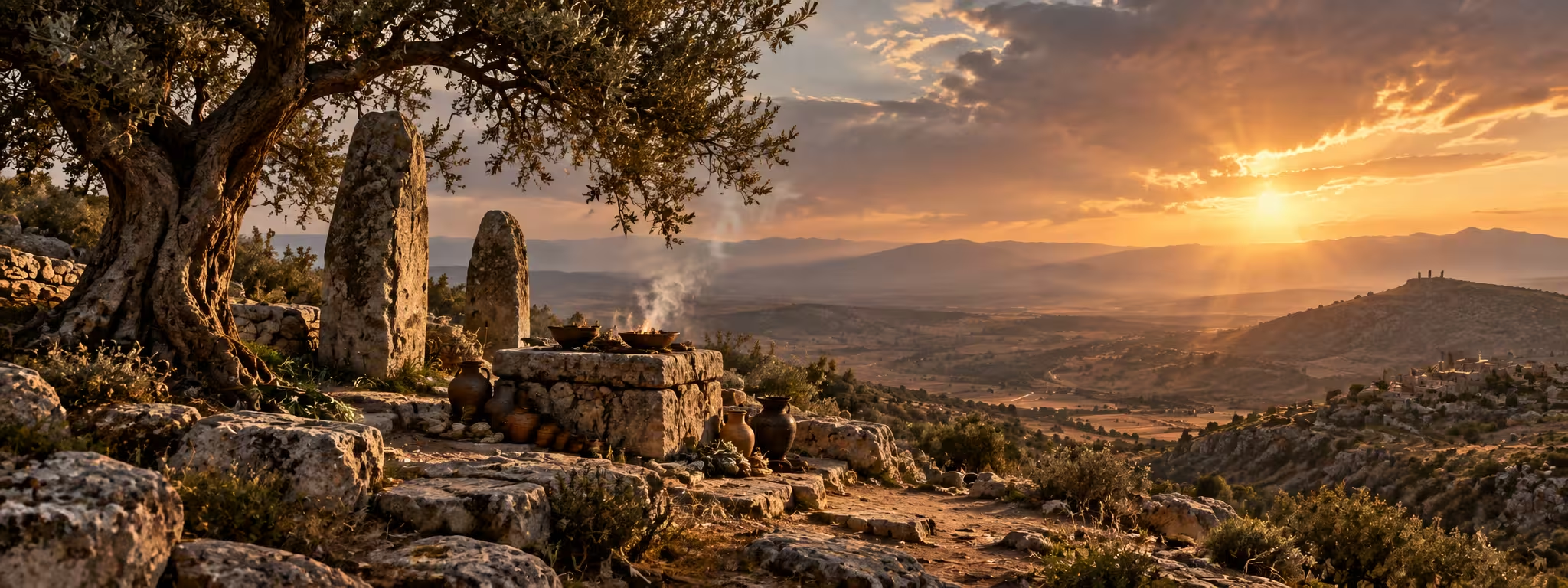
Ancient standing stone representing sacred places in the Levant
← Back to home

Explore a theme

Sacred
Places

Where people believed the sacred could be encountered—at stones, trees, altars, local sanctuaries, and eventually a temple that claimed a unique place.

The question

Why did some places become holy?

For most of Israel’s history, sacred space was not confined to one building in Jerusalem. People worshiped at local shrines, altars, high places, standing stones, springs, trees, and regional sanctuaries.

These places could preserve older traditions long after political and religious leaders began arguing that worship should be concentrated somewhere else.

Selected evidence

A few pieces of the record

The landscape itself preserves part of the story: many sacred places, competing centers, and eventually a growing claim that one city should stand above the rest.

Archaeology

Local altars and sanctuaries

Sites such as Arad and Beersheba preserve evidence for cultic activity outside Jerusalem, including shrine architecture and altar traditions.

What it suggests
Religious practice remained geographically diverse for much of the monarchic period.
What it does not establish
That every local shrine functioned in the same way or served the same deity.
Biblical memory & material culture

Stones, trees, and remembered encounters

Biblical traditions repeatedly connect divine encounters with standing stones, sacred trees, wells, mountains, and named places.

What it suggests
Holiness could attach to landscape and memory long before centralized temple worship.
What it does not establish
That every narrated sacred site can be recovered archaeologically or dated to the story’s setting.
Political religion

Jerusalem becomes different

As monarchy and temple institutions developed, Jerusalem acquired growing political and theological weight as a national sacred center.

What it suggests
Sacred geography could be reshaped by royal power, institutions, and later reform.
What it does not establish
That local worship disappeared as soon as Jerusalem’s claims became stronger.

The larger story

How did one city come to claim the sacred center?

The move from many local sacred places to an increasingly Jerusalem-centered religious ideal was neither immediate nor simple. Kingship, temple ideology, regional rivalry, Assyrian pressure, reform, destruction, and memory all changed what sacred space meant.

The book follows that transformation instead of beginning with its final form.