Find the strongest alternative
Do not compare the preferred model with a weak caricature. Test it against the best serious competing explanation.
AIRA Methodology
AIRA approaches the Bible as historical evidence that must be interpreted, situated, compared, and tested. Every major reconstruction is exposed to competing explanations and contrary evidence before it earns a place in the book.
How we investigate
The entire AIRA research process at a glance—from reading the text, to testing the world behind it, to counter-research, reassessment, and evidentiary confidence.
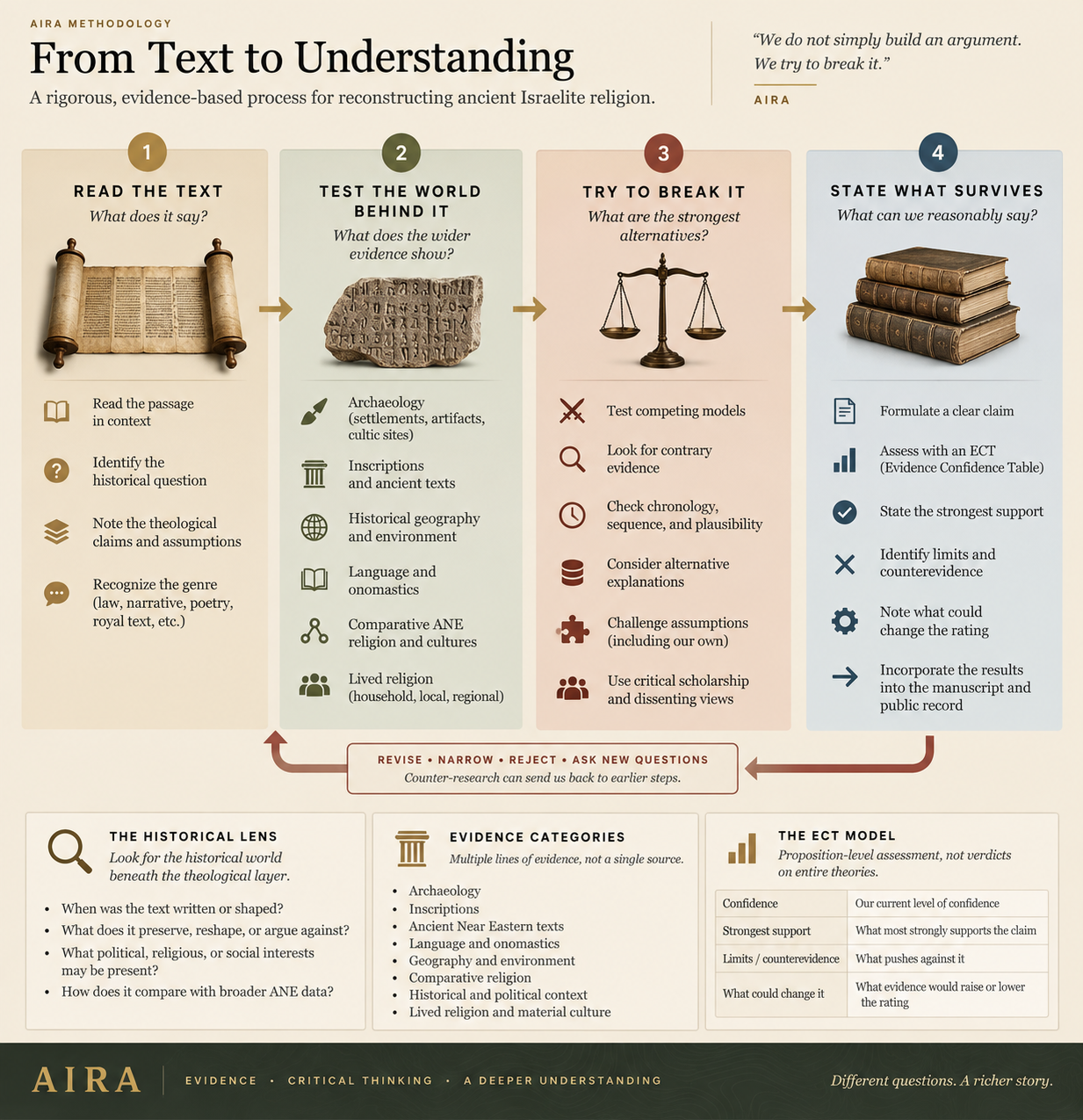
The historical lens
We read the biblical text closely without assuming that its theological explanation is a transparent transcript of the past.
Peeling back the theological layer
Theological claims matter historically because they tell us how biblical writers understood their world. But a theological explanation and a historical reconstruction are not the same kind of claim.
So AIRA asks a second set of questions beneath the text: What institutions, conflicts, inherited practices, political changes, sacred places, and human choices can be recovered behind the explanation?
The text explains Jerusalem's status through divine election.
When did royal and cultic concentration occur? What did kings, temples, labor, political economy, rival sanctuaries, and inherited sacred geography contribute?
The reconstruction must fit evidence beyond the theological claim itself.
Adversarial research
Once a model begins to look persuasive, AIRA deliberately turns against it. Counter-research is not a final fact-check. It is part of how the claim is built.
Do not compare the preferred model with a weak caricature. Test it against the best serious competing explanation.
Look specifically for archaeology, texts, chronology, or scholarship that creates trouble for the emerging conclusion.
A similarity may be real while the proposed explanation is wrong. Test inheritance, convergence, adaptation, polemic, identification, and direct dependence separately.
Ask whether the argument depends on a biblical chronology, a theological premise, uncertain dating, or an ethnic identification the evidence cannot actually establish.
Every mature proposition identifies the evidence that could raise or lower its confidence. The conclusion remains revisable.
Counter-research can strengthen a claim—but it can also narrow it, force a rewrite, replace the mechanism, or remove an attractive argument altogether.
See the method at work
A simplified example of the questions behind the book's treatment of Jerusalem.
The received tradition presents centrality as the result of divine election.
Earlier sacred landscapes include Shiloh, Bethel, Gibeon, local altars, high places, household religion, and regional sanctuaries.
Monarchy, administration, monumental building, labor mobilization, Phoenician expertise, temple economy, and royal patronage enter the reconstruction.
Test the scale of the early state, the persistence of competing sites, chronology, and whether later ideology has been projected backward.
Jerusalem's sacred status can be studied as historical concentration and monumentalization later expressed through the language of divine choice.
Where the process ends
ECTs preserve the final discipline: each proposition receives its own confidence rating and its own record of support, limitations, counterevidence, and conditions for revision.
Browse Evidentiary Confidence AssessmentsEl-bearing sacred geography and comparative historical evidence.
Toponyms can outlive cults; no contemporary Bethel inscription identifies El.
Direct Bronze or Iron Age cultic epigraphy from Bethel.