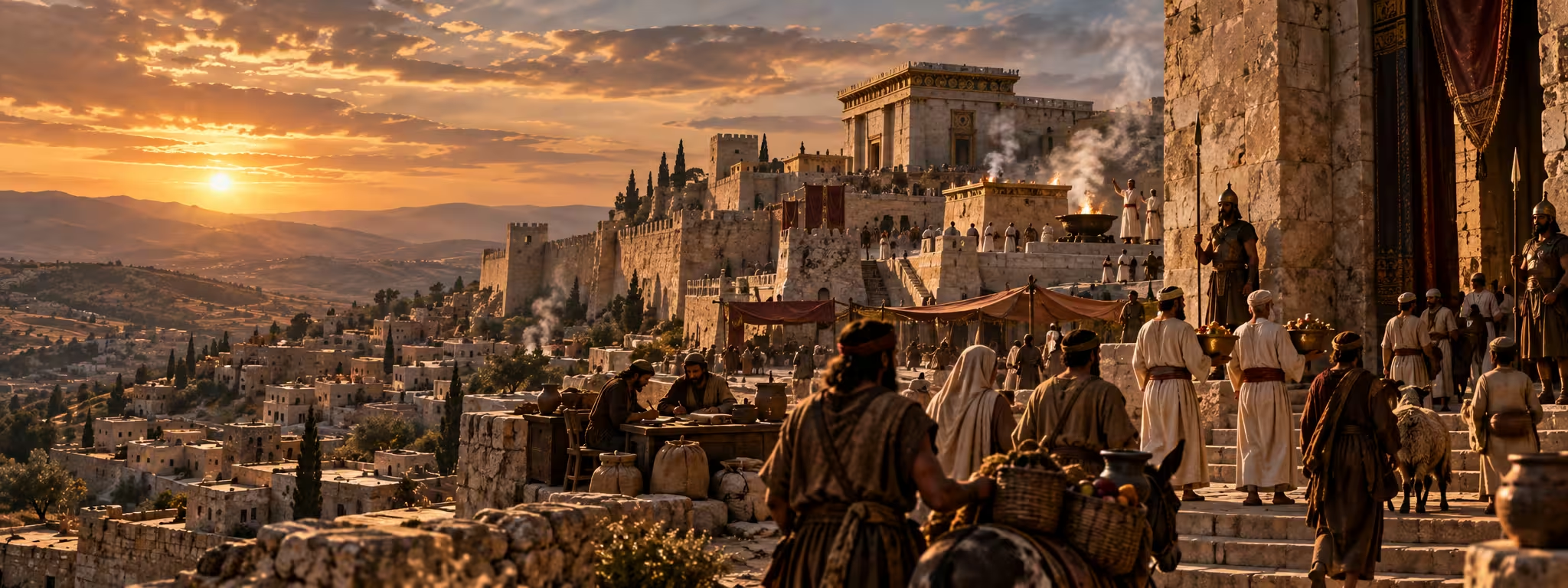
Kingship and temple institutions in an ancient southern Levantine city
← Back to home

Explore a theme

Kingship &
Temple

How kingship reshaped worship and sacred authority—and how Jerusalem became more than just another city with a shrine.

The question

What changes when religion becomes tied to the state?

Kings did more than govern. Across the ancient Near East, royal power and divine favor were deeply connected. Temples concentrated wealth, priesthood, sacrifice, legitimacy, and memory. Israel and Judah developed inside that same political world.

Once monarchy appears, religion begins to operate at a different scale—and sacred authority becomes entangled with national power.

Selected evidence

A few pieces of the record

These examples show how political institutions could reshape religious life without immediately erasing older local practice.

Royal ideology

The king and divine favor

Biblical royal traditions place the king within a sacred framework: chosen, anointed, protected, judged, and sometimes portrayed as central to the nation’s relationship with its God.

What it suggests
Kingship introduced a powerful new religious institution into Israel’s social world.
What it does not establish
That royal ideology always matched political reality or popular belief.
Temple & administration

Jerusalem gathers sacred authority

The Jerusalem temple linked dynasty, priesthood, sacrifice, treasury, national memory, and the theology of a chosen city.

What it suggests
Temple religion could reinforce royal power while giving Jerusalem exceptional religious weight.
What it does not establish
That Jerusalem was the only meaningful center of worship throughout the monarchic period.
Archaeology & historical texts

Crisis, reform, and centralization

Assyrian pressure, changes at sites such as Arad and Beersheba, and later reform traditions point to periods when older cultic arrangements were challenged or reorganized.

What it suggests
Religious centralization was a historical process tied to politics, crisis, and changing authority.
What it does not establish
A simple one-time reform that instantly transformed practice everywhere.

The larger story

Did Jerusalem become sacred because it was chosen—or because history made it so?

The answer lies in the interaction of dynasty, temple, theology, political rivalry, imperial pressure, reform, destruction, and memory. Jerusalem’s later centrality can make its earlier rise seem inevitable when it was anything but.

The book reconstructs how that transformation unfolded.